
HTWK Leipzig and Naturbau Campus have signed a cooperation agreement. The focus is on knowledge transfer, joint events and the development of a strong regional network
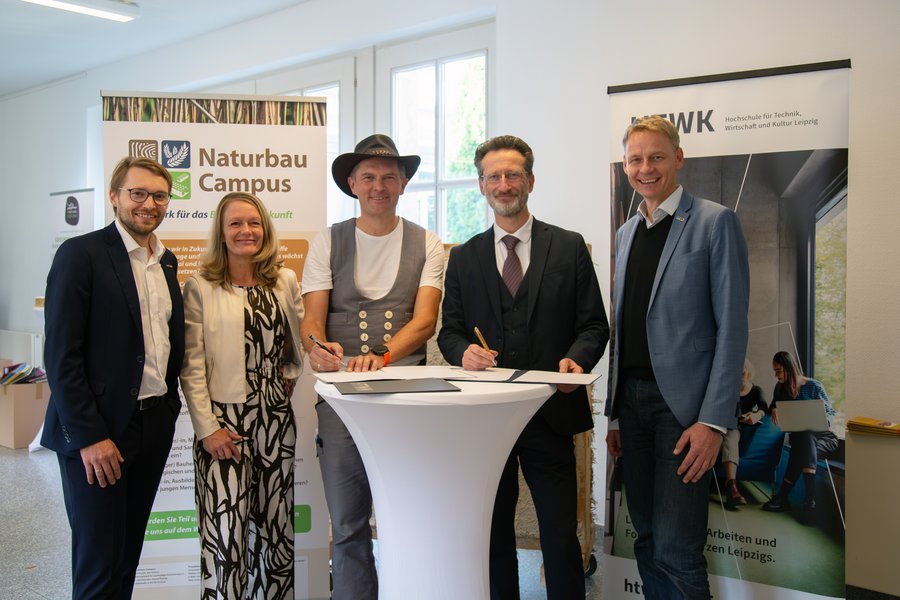
How can construction become more resource-efficient, regionally focused and sustainable? The academic world, the building trades and the regional economy are joining forces to promote sustainable construction using natural building materials. To this end, on 17 September 2026, the Rector of the Leipzig University of Applied Sciences (HTWK Leipzig), Prof. Dr.-Ing. Jean-Alexander Müller, and the association’s chairman, David Pfennig, representing the Naturbau Campus in Oschatz, signed a cooperation agreement. The collaboration operates under the umbrella brand ‘Building for Sustainable Development Leipzig’ (BNEL), which is primarily brought to life by HTWK professors Björn Höhlig and Alexander Stahr, as well as by Anja Helbig and David Pfennig from the Naturbau Campus.
Through this agreement, both partners aim to integrate their activities relating to sustainable construction more closely. The aim is to pool existing expertise and networks, initiate joint projects and events, and strengthen the exchange between research, planning, the skilled trades and businesses.
“When scientific findings find their way into practice and practical experience in turn sparks new research questions, the construction sector can become more sustainable,” says Prof. Dr.-Ing. Björn Höhlig, Professor of Sustainable Construction/Building Renovation at HTWK Leipzig. “To achieve this, we need strong networks. The collaboration with the Naturbau Campus facilitates direct dialogue with stakeholders who are already putting sustainable construction into practice today.”
From clay to wood: bringing together expertise at HTWK Leipzig
At HTWK Leipzig, sustainable construction is firmly embedded in a wide range of research and teaching activities. At the Faculty of Civil Engineering, Höhlig’s work focuses, amongst other things, on sustainable construction, clay, sustainable refurbishment and the renovation of existing buildings. Current research projects are examining, for example, how regional clay deposits can be utilised for the development of building materials, thereby strengthening regional value chains and material cycles.
Researchers at the Faculty of Architecture and Social Sciences are also working on sustainable construction methods. Prof. Dr.-Ing. Alexander Stahr, Professor of Structural Engineering, and his FLEX.institut at the Timber Construction Research Centre are researching, amongst other things, resource-efficient and digitally supported methods for timber construction. The combination of different materials, technologies and disciplines opens up new possibilities for sustainable construction methods.
“At HTWK Leipzig, we have a wide range of complementary areas of expertise – from building materials through design and fabrication to digitalisation. Together with partners from the region, we can put this expertise into practice more quickly whilst at the same time drawing on new insights from the field,” says Stahr.
Naturbau Campus as a link to construction practice
The Naturbau Campus sees itself as a centre for building with materials based on renewable or naturally occurring raw materials. On the site of the former felt factory in Oschatz, a venue has been created for educational, research and networking activities for stakeholders from the trades, planning, education, research and other sectors of the construction industry. The initiator and chairman of the supporting association, Bildungswerk für nachhaltige Entwicklung e. V., is master bricklayer and entrepreneur David Pfennig.
Pfennig brings with him many years’ experience in construction and the trade in building materials based on renewable or naturally occurring raw materials. He sees the central aim of the Naturbau Campus and this collaboration as being to introduce more sustainable solutions across the broader regional construction sector.
“The construction transition can only succeed if we bring science and practice much closer together,” says David Pfennig. “There are already many people and companies in the region who work with natural building materials and are breaking new ground. We want to forge stronger links between activities that have often taken place in parallel up to now. HTWK Leipzig contributes scientific expertise, whilst the Naturbau Campus brings practical experience – this can lead to concrete solutions.”
Taking action together
Plans include joint specialist events, workshops and other formats designed to bring together research findings, practical experience and new ideas. There are also plans to expand the existing network and to undertake joint research and knowledge transfer activities.
The collaboration builds on existing activities: experts from the fields of research, planning and construction practice already come together at the HTWK Leipzig for the ‘Sustainable Building and Renovation’ symposium. Most recently, at the third edition on 17 September 2026, the discussions focused, amongst other things, on natural building materials and timber-clay constructions.
The cooperation agreement, which the partners signed during the conference, will strengthen this collaboration in the long term. The aim is to create an effective regional network that integrates sustainable construction more firmly into day-to-day building practice.
